Showing posts with label green building. Show all posts

Thursday, January 26, 2017

The Living Building Challenge - The Forefront Of Green Building Is Here In Bend

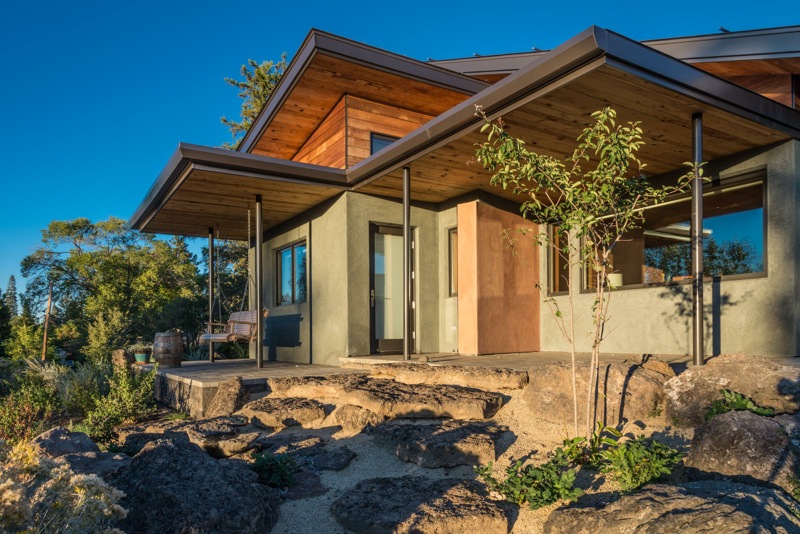
A new home in Bend, Oregon - where we're located - has officially been the first single family home in the country to meet the rigorous Living Building Challenge (LBC) standards. Going far beyond LEED Platinum, the LBC standards are effectively the gold standards of green building.


The Living Building Challenge (LBC) is a set of rigorous standards designed to be at the forefront of technology and green building innovation. The LBC has been set up to push development of these building technologies in the hope that they will become mainstream and cost-effective in the near future. Whereas LEED standards attempt to slowly bring mainstream buildings towards a greener composition, LBC attempts to dramatically push innovation for a very small number of structures, becoming an exercises in envelope-pushing engineering, architecture, and design.

This house - named Desert Rain - must be a net producer of energy and water, and cannot rely on any outside sewer services. Using solar and rainwater collection, the structure is completely self sustaining, without any impact on the environment. "Greywater" from showers and sinks is naturally filtered under the house without the use of chemicals, essentially using natural permeation to clean and recycle water. To cut down on the impact of material transport, all materials must come from within 1,500 miles, one-third of which must originate from within 300 miles of the structure. Stucco and interior walls were made from a local combination of sand, lime, and clay, avoiding drywall and other manufactured products.


As one would expect, the unorthodox building process for this 5,000 sqft house did come at a high price. Totalling $3.48 million, Desert Rain boasts a $638/sqft cost. For now, Desert Rain exists as an monument of what is possible, and what will become the new normal decades from now. To learn more about the Desert Rain project, check out OPB's website here.


Tuesday, September 22, 2015

Cross-Laminated Timber, A New Building Trend On The Rise

Last Thursday news broke that America's first two cross-laminated timber low-rise buildings were set to break ground. These tall wood buildings in New York and Portland, Oregon are primed to set the future trend of using cross-laminated timber (CLT) in residential and mixed use projects.

The Framework Building, soon to be built in Portland
CLTs are solid wood-based structural panels created from dimensional lumber stacked at right angles, in multiple layers. Once stacked, the wood is put under pressure and bonded with an adhesive. CLTs can be produced one foot thick, and up to 40 feet long. CLT technology is currently being used in Europe and Canada to produce structures ranging from six to 14 stories tall.

Cross-Laminated Timber
The rising popularity of CLTs is a big deal because they often allow faster and cheaper construction than commonplace steel and concrete counterparts. Furthermore, many argue that CLTs are a more environmentally friendly building material; as the wood can be sustainably sourced and the timber absorbs carbon through its life cycle. Additionally, the burgeoning rise of mass timber has already sparked the development of multiple CLT plants in Oregon and Montana, which advocates point at as evidence supporting CLTs as job-creating.

Ground floor of the Framework Building
However, the regulations surrounding CLTs are still very complex and burdensome to navigate. This is the biggest reason CLTs have not yet become commonplace in the United States. The CLT projects in Portland and New York only became feasible upon receiving a $1.5 million grant to allow them to work through the evolving set of mass timber regulations. As these trailblazing projects progress, expect to see more CLT plans announced.

Friday, September 18, 2015

Green Building Jobs Are On The Rise

According to a new article published by Houston online newspaper Chron, Green Building jobs are growing faster than construction jobs in any other sector.

Overall, green building jobs now account for more than one-third of all building jobs, a proportion that's set only to continue rising.

Green projects like this now account for an increasing percentage of all projects

To cash in on green building, we offer an array of environmentally friendly surface protection products, all of which can be seen on our website here.

Thursday, July 9, 2015

Top 10 Things to Recycle at Your Construction Site


In this article, John Perritano rates the top 10 things to recycle-saving you money and the environment as well!  

According to the Construction Materials Recycling Association, construction and demolition waste are the largest sources of trash in the United States. The association says 325 million tons of recoverable construction debris is generated in the United States each year [source: Construction Materials Recycling Association]. In the past, all that metal, concrete, wood, block and asphalt would have ended up in a landfill. The key to a successful deconstruction project is to reuse what you can, and recycle the rest.
While not every bit of construction and demolition debris can -- or even should -- be recycled, much of what goes into a house can be reused. More information and the list is located with this link:
http://home.howstuffworks.com/home-improvement/construction/green/10-things-to-recycle-at-construction-site.htm#page=0
Wood and Lumber
Drywall
Steel
Roofing Shingles
Glass and Windows
Landscape Waste
Appliances
Concrete and Masonry
Asphalt
Copper